
Performance Conclusion: At power densities exceeding 50W/cm², the low thermal conductivity of Alumina (Al₂O₃) becomes the primary cause of system failure. CERAMPRO laboratory data confirms that Aluminum Nitride (AlN) ceramics, with thermal conductivity up to 230 W/m·K (7x higher than Alumina), effectively eliminate "Heat Traps" in semiconductor packaging. Its CTE matching with Silicon fundamentally solves interface delamination under high-frequency thermal cycling.
Economic ROI: While AlN has a higher initial CapEx, its superior thermal performance reduces power module failure rates by ~30% and extends component life by 3x. In 5G and EV applications, switching to AlN simplifies cooling infrastructure, with total OpEx expected to break even within 18 months.
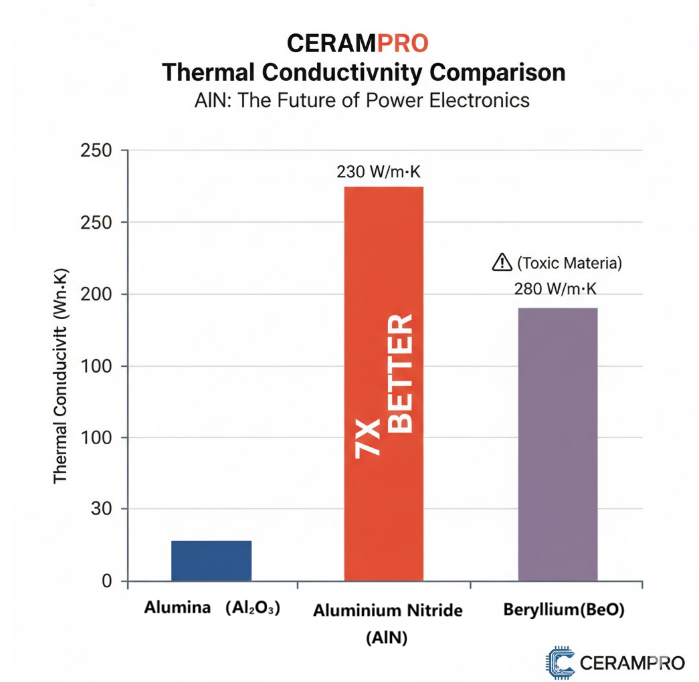
Thermal Performance Comparison Chart
In high-stakes industries like
Unlike metals that rely on electrons,
| Criteria | Alumina (Al2O3) | Aluminum Nitride (AlN) | Beryllia (BeO) |
| Thermal Performance | Low | High (7x Alumina) | Ultra-High |
| Mechanical Strength | High | Medium-High | Medium |
| Safety & Toxicity | Non-toxic | Non-toxic | Highly Toxic |
| CTE Match to Silicon | Poor | Excellent | Poor |
| Scalability (Cost) | Low CapEx | Best Long-term ROI | High (Regulated) |
AlN is highly sensitive to hydrolysis. To prevent material degradation during fabrication, our CNC facility enforces strict anhydrous grinding standards:
Zero Contamination: We use 100% specialized synthetic oil-based coolants (no water) to maintain semiconductor-grade purity.
Sub-Micron Precision: Diamond-tipped tooling achieves a flatness of ∓0.002 mm, critical for the thermal contact of high-power IGBT modules.
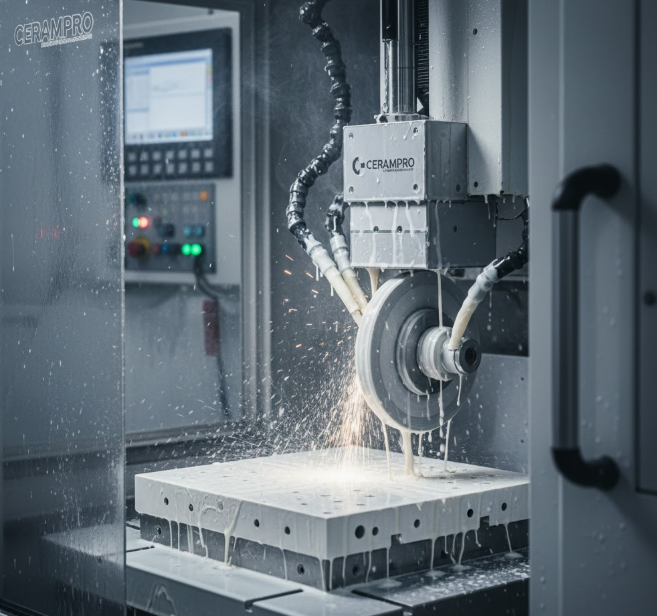
Machining Detail
Q1: How does AlN compare to Beryllia (BeO) in modern applications?
A: While BeO has higher conductivity, it is highly toxic. AlN provides a safer, eco-friendly alternative with nearly comparable performance (up to 230 W/m·K), making it the modern "Gold Standard" without regulatory burdens.
Q2: Does CERAMPRO provide metallization for AlN substrates?
A: Yes. We offer specialized Mo-Mn, DBC, and AMB metallization. Our AMB (Active Metal Brazing) ensures high bond strength for copper layers, ideal for extreme vibration environments.
Q3: Why is "Anhydrous Processing" critical?
A: Hydrolysis destroys surface integrity and causes "outgassing" in vacuum environments. For semiconductor clients, treated AlN ensures no contamination and higher manufacturing yields.
Quality Assurance: All aluminum nitride components produced by CERAMPRO comply with RoHS and REACH environmental standards, and have undergone strict ultrasonic flaw detection (Scanning Acoustic Microscopy) to ensure there are no internal pores or cracks.
Choosing the right substrate is a strategic decision for product reliability. If you are facing overheating issues or substrate cracking, our engineering team is ready to assist.
[Request an AlN Sample for Testing]
Author Profile: This article is released by the CERAMPRO Ceramic Engineering Laboratory. We specialize in providing precise processing and metallization solutions for high-performance ceramic materials, helping global power semiconductor customers overcome thermodynamic limitations.

